Shopify Packaging Boxes: Custom Shipping Box Starter Guide
Shopify packaging boxes should be selected by the job each layer must do: a corrugated mailer or shipper protects the order through delivery, while a folding carton or rigid box presents the product inside. For many Shopify brands, the most reliable system is not one box trying to do everything. It is a right-sized outer shipping box plus an inner package chosen for the product, price point and unboxing experience.
This starter guide compares custom Shopify shipping boxes, folding cartons and rigid boxes using JCL Packaging’s published materials, minimum order quantities, sample times and production lead times. It also shows what information to send a factory before requesting a quote.
Quick answer: which Shopify packaging box should you choose?
Start with the shipping path, not the finish. If the package will travel through a parcel network without another protective carton, choose a custom corrugated mailer or shipper. If the package sits inside an outer shipper, choose a folding carton for efficient retail-style presentation or a rigid box for a heavier, pre-formed gift experience.
| Packaging type | Best role in a Shopify order | Published material | Standard MOQ | Sampling | Production after approval |
|---|---|---|---|---|---|
| Corrugated mailer | Direct-to-customer shipping and subscription kits | E-, B-, C-flute or BC double-wall board | 1,000 pcs | 3–5 days | 10–15 days |
| Folding carton | Product box inside a mailer; cosmetics, supplements, food or accessories | 250–400 gsm cardstock | 1,000 pcs | 3–5 days | 10–15 days |
| Rigid gift box | Premium sets, electronics, candles and gift tiers | 1200–2000 gsm greyboard, 1–3 mm | 500 pcs | 5–7 days | 12–18 days |
| Printed cards and inserts | Thank-you cards, manuals, warranty cards and hang tags | Paper and card stocks matched to the packaging | 500 pcs | 2–5 days | 7–12 days |
These are planning figures, not a substitute for a project quote. Structure, dimensions, materials, printing, finishes, insert requirements and destination all belong in the first brief.
1. Separate shipping protection from product presentation
A Shopify shipping box must survive handling and arrive presentable. Corrugated construction is designed for that outer job. JCL offers E-flute at 1.5 mm, B-flute at 3 mm, C-flute at 4 mm and BC double-wall board, with offset-laminated CMYK or flexographic printing. Mailer, roll-end tuck-top, regular slotted shipper and die-cut tray structures are available.
The inner package can then focus on the product. Custom folding cartons ship glued flat and support reverse-tuck, straight-tuck, auto-bottom, sleeve and two-piece structures. Custom rigid boxes arrive pre-formed and support lid-and-base, magnetic book-style, drawer and shaped constructions.
The two-layer approach is especially useful when the product package should look refined but does not need to carry the full courier load alone. JCL’s published carton guidance makes the same distinction: a folding carton is the retail presentation, while a corrugated mailer is the courier-ready outer layer.
2. Choose structure before finishes
The structure controls fit, packing speed and protection. Finishes should be added only after the box style and dimensions are approved.
For corrugated mailers, choose between:
- E-flute for a thinner wall and premium printed surface.
- B-flute for a balance of cushioning and print presentation.
- C-flute for greater stacking strength on heavier products.
- BC double-wall when the project needs a stronger corrugated construction.
For folding cartons, choose the opening and base around the packing process. An auto-bottom carton can be supplied pre-glued flat, while tuck-end cartons and sleeves suit different product-loading directions. For a higher-value set, rigid boxes can use EVA foam, molded pulp, corrugated, silk or vacuum-formed inserts to hold products and accessories in place.
If freight efficiency is the main question, use the full mailer box sizing guide after the product, protective wrap and insert arrangement are known. JCL engineers internal dimensions around the product rather than forcing it into an off-the-shelf size.
3. Send a quote brief that a factory can actually price
A useful first inquiry should include:
- Product dimensions and packed weight.
- Required quantity for each design or SKU.
- Preferred box type, or permission for the factory to recommend one.
- Printing direction: CMYK artwork, PMS spot colors or a simpler flexographic design.
- Desired finish, such as matte, gloss or soft-touch lamination, foil, spot UV or embossing.
- Insert requirements for products, accessories, cards or manuals.
- Delivery country, postal code and required arrival date.
- Print-ready artwork if available, or a request for a structural dieline first.
JCL’s process starts with an inquiry and a detailed quote within 24 hours. The structural dieline is prepared before artwork placement. Print-ready files should be supplied as AI or PDF with fonts converted to outlines, images at 300 dpi and colors in CMYK, plus PMS numbers for spot colors.
4. Use one controlled color and finishing workflow
Shopify brands often need several printed pieces to look like one system: an outer mailer, inner carton, thank-you card, manual and hang tag. Producing them through one color-management workflow reduces avoidable variation between those touchpoints.
JCL’s equipment list includes Heidelberg CD102 four- and five-color offset presses, a Heidelberg PM74 press and a CTP computer-to-plate system. The factory capabilities page also documents automatic film lamination, die-cutting, box gluing, V-grooving, hot foil stamping and rigid-box visual positioning.
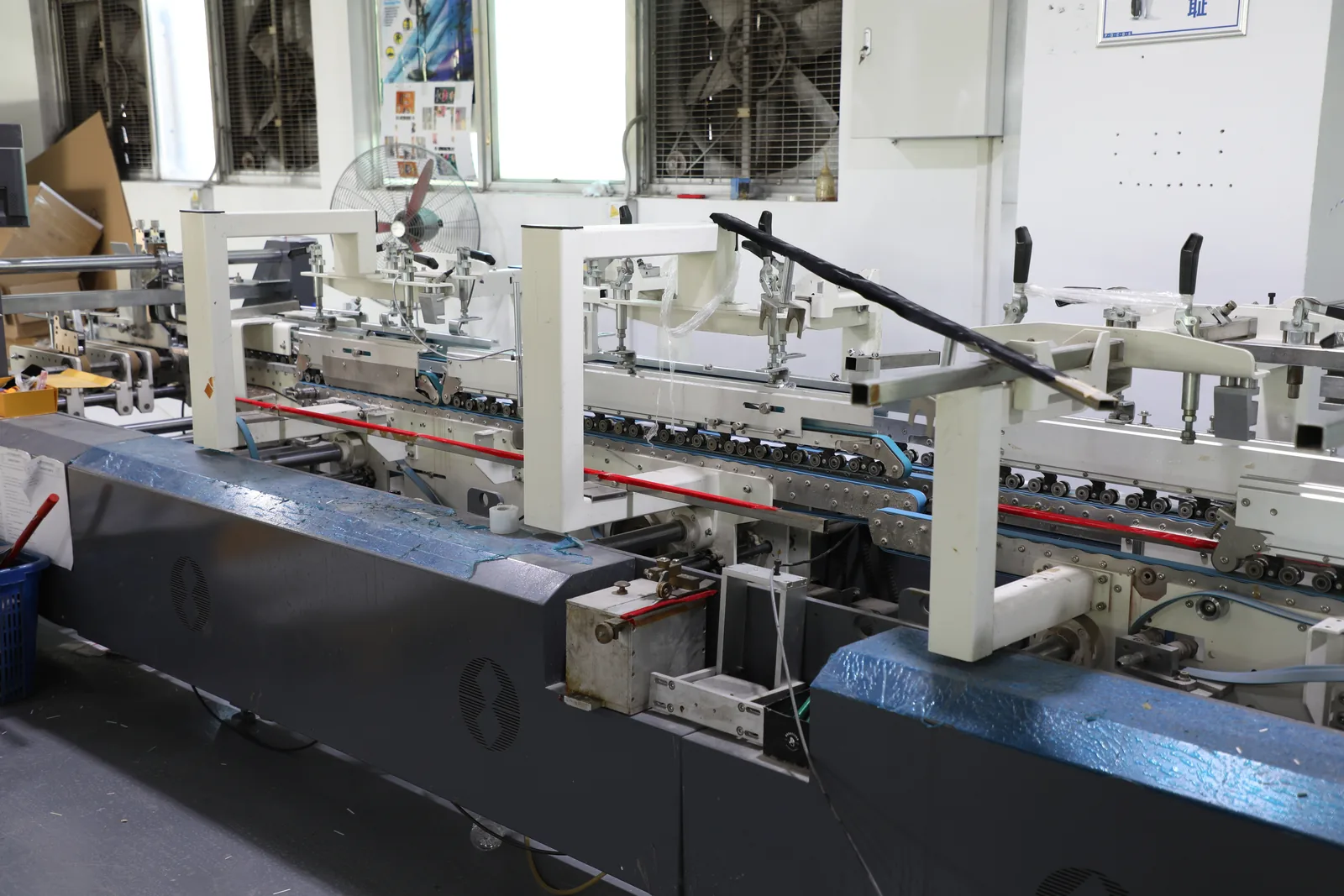
The factory photograph above shows JCL’s A-tier automatic folder-gluer production line. The master media catalog identifies this scene as automatic box gluing, folding and conveying for folding-carton production. It is the physical step that turns printed and die-cut sheets into consistent glued cartons before packing.
For brand-critical color, JCL supports CMYK offset printing and PMS spot colors. Printed color drawdowns can be approved before mass production, and the same packaging finishes can be applied to custom cards, tags and printed inserts.
5. Approve a physical sample before production
The pre-production sample should use the specified stock, structure and finishes. Sampling takes 3–5 days for corrugated mailers and folding cartons, 5–7 days for rigid boxes, and 2–5 days for cards and other print materials.
For confirmed orders, the pre-production sample is free; the buyer covers the sample courier, typically $30–60 by DHL or FedEx. Production begins only after sample sign-off. Use the sample to confirm product fit, closure, insert position, artwork placement, color direction and the packing sequence your team will repeat.
The production workflow then moves through mass production and quality control. JCL states that every shipment receives final AQL inspection, with photo reports before packing. Automatic die-cutters and gluers are used to hold consistency through the run.
6. Plan cash, production and delivery together
Standard payment terms are a 30% deposit with the order and a 70% balance before shipment by bank transfer. PayPal is accepted for sample courier fees and small trial orders, while LC at sight can be discussed for large contracts.
For a launch calendar, work backward from the required arrival date:
- Quote and dieline: quote within 24 hours, followed by structural and artwork preparation.
- Physical sample: 3–5 days for mailers and cartons; 5–7 days for rigid boxes.
- Mass production: 10–15 days for mailers and cartons; 12–18 days for rigid boxes.
- Quality inspection and packing: completed before the shipment leaves the factory.
- Delivery: express, air, LCL or FCL sea freight, with worldwide DDP door-to-door available.
DDP means JCL can handle export clearance, duties and taxes so the shipment arrives like a domestic delivery. The freight route should be quoted with the packaging order rather than treated as an afterthought.
A practical first order for a Shopify brand
A clear starter specification usually looks like this:
- One corrugated mailer sized to the packed product.
- One folding carton or rigid box only if the product needs a separate presentation layer.
- One controlled finish, such as matte lamination, foil, spot UV or embossing.
- A physical sample approved before mass production.
- Matching printed materials only when they support the customer experience or required instructions.
- A quote that includes the destination and DDP option.
Do not start by asking for “the cheapest custom box.” Start with the product, shipping path, order quantity and arrival date. Those inputs let the factory recommend the simplest structure that can protect the order and still present the brand correctly.
Send your product dimensions, quantity and delivery destination to receive a structure recommendation, dieline, production timeline and factory-direct quote within 24 hours.