Air vs Sea Freight for Custom Packaging Boxes: Cost per Box
Air vs sea freight for custom packaging boxes should be compared by landed cost per usable box, not by one freight total in isolation. The right route depends on the order quantity, how densely the packaging can be packed, when it must arrive, and whether the structure ships flat or pre-formed. A smaller air shipment can protect a launch date, while a larger sea shipment can support planned inventory. The useful question is therefore not “Which mode is always cheaper?” but “Which route gives this order the best cost per box at the required arrival date?”
JCL Packaging ships worldwide by express, air freight, LCL sea freight and FCL sea freight. DDP door-to-door is available, so the freight plan can include export clearance, duties and taxes instead of leaving those items as later surprises. Because every destination and packed order is different, we quote the box price and the route-specific delivery cost together.
Start with landed cost per box
Use one comparison for every route:
Landed cost per box = packaging order value + freight + route-related clearance, duties and taxes, divided by the number of boxes received.
If the quotation is DDP, the delivery plan already combines the international movement and import-side charges into the quoted route. If you use another shipping term, keep the charges outside the factory invoice in the same calculation. The goal is to compare like with like.
A freight total can look large while still producing a sensible cost per box across a full production run. The opposite is also possible: a low-looking shipment total may cover only part of the order, require a second shipment later, or arrive too late for the campaign it was meant to support. Put quantity, arrival date and all route charges on one sheet before choosing.
Air freight and sea freight solve different problems
| Decision point | Air freight | LCL or FCL sea freight |
|---|---|---|
| Best planning role | Smaller or urgent production quantities | Planned replenishment and larger production quantities |
| Main cost pressure | Packed volume and weight | Shipment volume, handling plan and total load |
| Strong use case | Launch stock, samples beyond courier size, urgent replenishment | Full runs with a stable arrival window |
| Packaging priority | Remove empty space and avoid unnecessary external volume | Pack efficiently for handling, stacking and storage |
| Quote input | Packed dimensions, gross weight, quantity and destination | Packed dimensions, gross weight, quantity, destination and load plan |
| Available service | Air freight, with DDP available | LCL or FCL sea freight, with DDP available |
Air freight is a schedule tool as much as a transport mode. It can move the quantity needed for a launch or stock recovery without waiting for the larger inventory plan. Sea freight is an inventory tool: it is most useful when the order can be planned against production, inspection and the required arrival date.
Do not split an order automatically. A split only makes sense when the first quantity has a defined job, such as covering a confirmed launch while the balance follows by sea. Otherwise, two bookings can create more handling and more inventory administration without solving a business problem.
Packaging construction changes the freight comparison
The same unit count can occupy very different packed volumes. That is why the box structure must be part of the shipping decision.
Custom printed boxes use 250–400 gsm cardstock and are supplied glued flat. JCL’s product specification states that flat-packed cartons can reduce air-freight volume by up to 60% compared with rigid boxes. Their standard MOQ is 1,000 pieces, sampling takes 3–5 days, and production takes 10–15 days after sample approval.
Custom rigid boxes use 1200–2000 gsm greyboard at 1–3 mm thickness and arrive pre-formed. They create a substantial presentation structure, but they do not collapse into the same flat stack as a folding carton. Their standard MOQ is 500 pieces, sampling takes 5–7 days, and production takes 12–18 days after sample approval.
Corrugated mailers and shippers are engineered in E-flute, B-flute, C-flute or BC double-wall structures. They can be right-sized to the product plus wrap and insert, reducing avoidable empty volume. Their standard MOQ is 1,000 pieces, sampling takes 3–5 days, and production takes 10–15 days after sample approval.
| Packaging type | Standard MOQ | Packed form or freight factor | Standard production after approval |
|---|---|---|---|
| Folding cartons | 1,000 pcs | Glued flat; dense stacking | 10–15 days |
| Rigid boxes | 500 pcs | Pre-formed; presentation structure occupies more volume | 12–18 days |
| Corrugated mailers | 1,000 pcs | Flute and right-sizing determine external volume | 10–15 days |
This table does not select the route for you. It shows why a route comparison must use the final packed specification rather than an early product sketch. A 1,000-piece folding-carton order and a 1,000-piece rigid-box order are not equivalent freight loads.
Reduce freight before choosing the route
The highest-leverage freight decisions happen during structural design, before a shipment is booked.
- Choose the correct construction. A folding carton is efficient for retail presentation and ships flat. A rigid box supports a premium pre-formed presentation. A corrugated mailer is designed for courier protection and fulfillment. Do not force one structure to do another structure’s job.
- Right-size the internal dimensions. Product, wrap, insert and working clearance determine the internal cavity. Extra space then repeats across every carton and every shipment.
- Use inserts deliberately. Corrugated dividers, molded pulp, EVA foam, vacuum-formed trays and paper cradles hold products differently. The insert should control movement without creating unnecessary outer volume.
- Confirm the packed master-carton data. Route quotes should use the packed dimensions, gross weight and carton count, not only the dimensions of one retail box.
- Compare one complete specification. Keep the quantity, box construction, finish, packing method and destination unchanged when comparing air and sea.
JCL includes structural engineering in the project workflow. The dieline is prepared around the product dimensions, wall thickness, clearance and insert needs before mass production. The factory capabilities page shows the in-house printing, lamination, die-cutting, gluing, rigid-box wrapping and quality-control stages used to turn that specification into a repeatable order.
Why inspection belongs in the freight plan
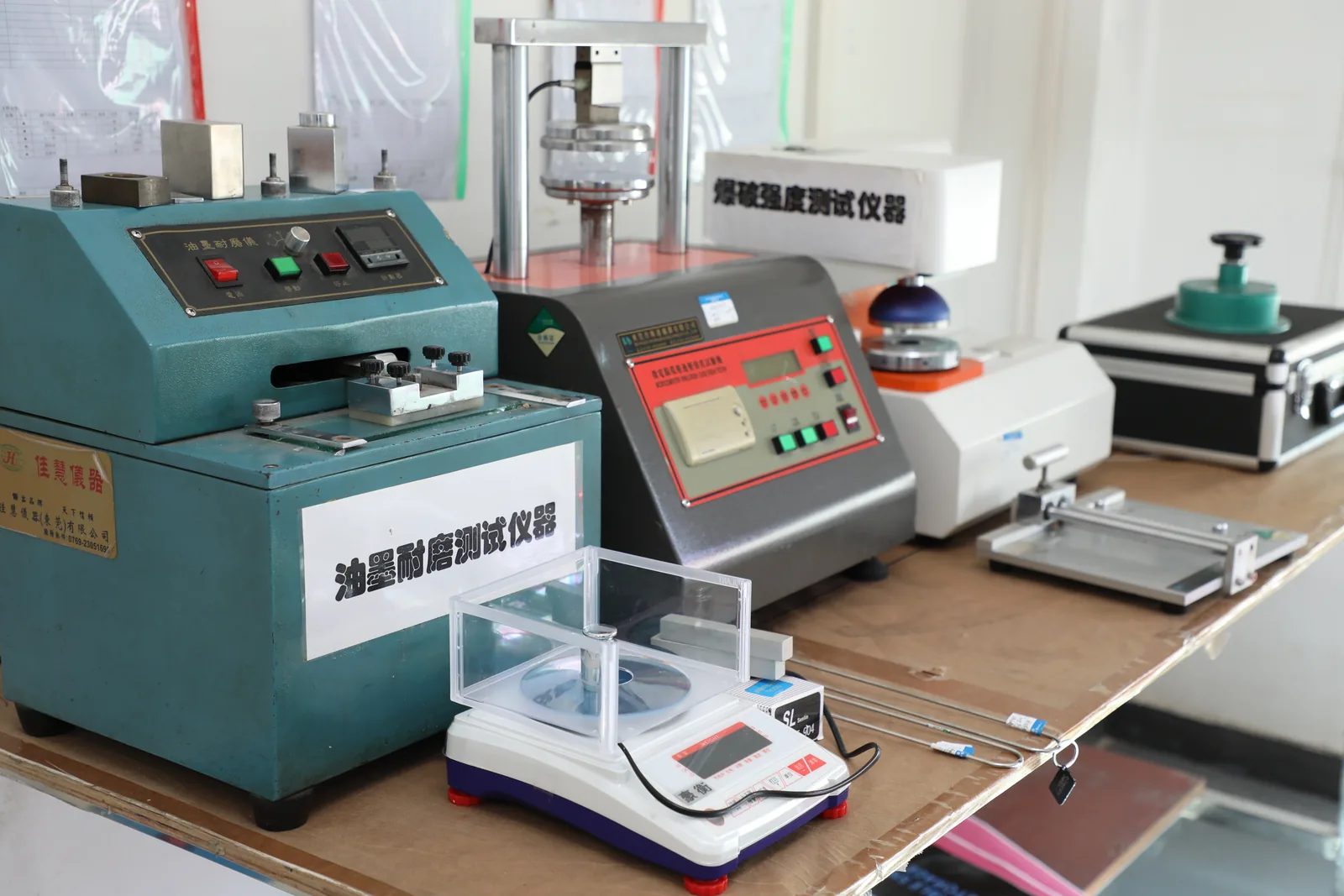
The real factory image above shows packaging quality-testing instruments in JCL’s in-house lab. Every shipment passes a final AQL inspection, and photo reports are sent before the goods leave the factory. That release point matters because freight should be booked against approved, inspected goods rather than an assumed production finish date.
A practical schedule therefore works backward from the required arrival date through route-specific delivery, final inspection, mass production and sample approval. Folding cartons, corrugated mailers and paper bags normally take 10–15 days in production after approval; rigid boxes and wine boxes take 12–18 days. The full sequence is explained in our custom packaging lead-time guide.
If the launch date is fixed, state it in the first inquiry. JCL can confirm whether rush production is available when the press schedule allows, but the shipping route still needs its own plan. Compressing factory time and selecting air freight are separate decisions, and both should be visible in the quotation.
When DDP makes the comparison clearer
DDP door-to-door can make air-versus-sea evaluation easier because export clearance, duties and taxes are handled within the shipment plan. You receive a landed delivery quotation instead of comparing a factory invoice with an incomplete freight estimate.
DDP is not the only available structure. Buyers with their own freight arrangements may prefer another term, particularly when they already control international logistics. The important discipline is to include every charge in the landed-cost calculation. Our DDP shipping guide explains the available shipping-term choices in more detail.
Information needed for an air-versus-sea quote
Send the following in one brief:
- Packaging type or the product dimensions if the structure is not decided
- Finished box dimensions and order quantity per design
- Material, printing and finishing direction
- Insert requirement and product weight
- Destination postal code
- Required arrival date
- Whether you want DDP door-to-door pricing
- Whether part of the order has a separate launch deadline
JCL’s process begins with inquiry and quote, followed by dieline and artwork, physical sample, mass production, quality inspection and worldwide delivery. A complete inquiry receives a detailed quotation within 24 hours.
The final route should support the commercial plan, not merely win one line of a spreadsheet. Use air for a defined urgent quantity when time has measurable value. Use sea for planned inventory when the schedule allows it. In both cases, compare the same approved packaging specification and calculate the landed cost per box.
Send your box size, quantity, destination and required arrival date to receive a route-specific comparison for express, air, LCL or FCL sea freight, including a DDP option where appropriate.